


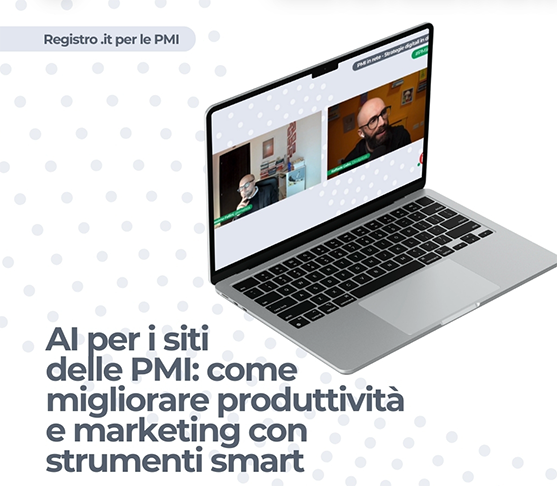
On 21 January, the third LinkedIn live session of the Registro .it took place, dedicated to the use of artificial intelligence applied to the websites of small and medium-sized enterprises and freelancers, with an in-depth analysis on the themes of productivity, digital marketing and online visibility in a rapidly evolving context. The meeting, entitled “AI for SME websites: how to improve productivity and marketing with smart tools”, saw the comparison between Massimo Fellini, journalist and moderator of the live session, and Raffaele Gaito, trainer and expert communicator in digital technologies.
Right from the start, the current state of AI adoption in businesses became clear: a widespread awareness of its potential does not yet correspond to a broad implementation of structured projects. As Massimo Fellini pointed out, “only 30% of Italian small and medium-sized enterprises is implementing structured artificial intelligence projects", despite the fact that the majority of entrepreneurs recognise their value in terms of productivity and their focus on strategic activities with high added value, such as the development of new products and services.
In this scenario, the website continues to play a central but deeply evolved role. With the rise of conversational searches and generative AI tools, the website is no longer just a destination for search engines, but an authoritative and structured source of information, able to feed and qualify the responses provided by the new digital research and assistance systems. It was from the dialogue with Raffaele Gaito that the need for a paradigm shift in content optimisation emerged: no longer an approach focused exclusively on keywords, but a design oriented to people’s real questions and needs. To be truly relevant, websites must offer structured, clear and useful content that can respond to users’ concerns, needs and objections in a timely manner. To address these new needs, AI can support businesses in analysing their audiences and building more effective content, as long as it remains a tool to support and not replace human thinking.
During the live session, emphasis was placed on AI-generated content and the risk of a proliferation of standardised and unremarkable texts. The problem with so-called “photocopy content” lies not in the technology itself but in the absence of any real human contribution: the value of content lies in experience, concrete cases, proprietary data and perspectives gained over time, elements that enable the building of authority and trust. In this perspective, AI acts as a co-pilot, accelerating processes and supporting production, but always under the guidance of people. The uniqueness, as Gaito has highlighted, does not depend on the topic, but on the way in which it is told: “we must not be obsessed with being the only ones talking about something, but talking about something in a unique way”.
Significant attention was also given to the topic of productivity. Gaito described AI as a real time multiplier, freeing up resources from repetitive, low-value-added tasks, such as drafting first drafts, translations, analysing large volumes of data or managing recurring responses. On the contrary, strategic, decision-making and relationship activities, which require critical thinking, sensitivity and understanding of context, remain the prerogative of human beings. It is precisely in this balance between automation and human intervention that the key to the effective and sustainable use of artificial intelligence lies. Gaito summed up this vision with a metaphor: “AI is a springboard that helps you jump higher, but you have to make the jump yourself”.
Another topic of debate was online visibility in the age of “zero-click” searches, along with the growing impact of generative AI tools on website traffic. It was emphasised that the website should be part of a wider ecosystem of channels and formats, including video content, social media, newsletters, webinars and downloadable materials. From this point of view, the website becomes the point of convergence and deepening, the place where the relationship with the user is consolidated and the conversion is carried out, whatever it is (e.g. contact the company, subscribe to a newsletter or buy a product).
Finally, the last point discussed in the session was the adoption of artificial intelligence tools, along with the need for a methodical and aware approach. In a context of rapid proliferation of solutions and platforms, the importance of avoiding indiscriminate use of tools has emerged, favouring instead the definition of concrete use cases and internal benchmarks. The choice of tools must be driven by the ability to respond to real needs and to generate a measurable impact on the processes and results of the organisation. As Raffaele Gaito clarified, “it is not necessary to have 100 subscriptions but tools that solve problems”, tested on real cases to assess their effectiveness.
Moreover, the choice between different platforms depends on specific needs: the Google ecosystem may steer towards Gemini, those who work extensively with code may prefer Claude or development-oriented tools, while for beginners ChatGPT is a complete and versatile starting point.
In conclusion, the live session highlighted that AI is not a shortcut but a strategic opportunity to rethink the role of the website and digital content of SMEs and professionals. It is not about delegating value creation to machines, but about using smart tools to enhance human skills, increase process efficiency and strengthen the relationship with the public. In a digital environment increasingly driven by conversational systems and immediate responses, entrepreneurs and professionals who know how to integrate AI in an informed way, while maintaining focus, vision and authenticity, will be the ones best able to stand out, grow and build trust over time.