


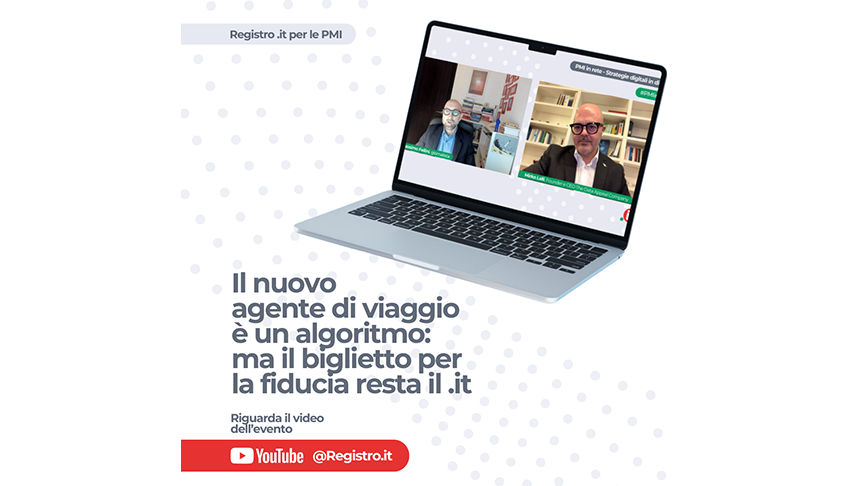
On 17 February, the fourth LinkedIn live session of the Registro .it was held, entitled “The new travel agent is an algorithm: but the ticket to trust remains .it”, which saw the dialogue between Massimo Fellini, journalist expert in digital transformation, with Mirko Lalli, Founder and CEO of the Data Appeal Company. The comparison deepened the impact of artificial intelligence on the tourism sector, analysing changes in traveller behaviour and the continued role of the website, and - in particular - of the .it domain, in an increasingly algorithmic-driven scenario. In this regard, Fellini introduced the theme by highlighting that “the website remains the identity compass for every type of destination and operator.
The .it domain is the hallmark of trust”. According to Lalli, who contextualised tourism data in 2026, “despite geopolitical tensions, the sector continues to grow, and the share of active travellers will increase by almost 4%”.
During the live session, data was shared showing a clear evolution: 39% of travellers use generative AI tools to organise their trip. The figure, analysed by age group, rises to 58% among Millennials and Generation Z. Moreover, a significant share of young people (41%) say they trust AI advice more than that of friends or social media. This is a cultural change rather than a technological one: it goes from people “looking for” information online to people “asking” a conversational assistant to suggest a solution, often unique, for hotels, restaurants or destinations.
This confidence in AI translates into concrete choices that directly affect the dynamics of online visibility. Recent research of Kayak, the metamotor for flight comparisons, shows that: “51% of respondents changed destinations based on recommendations received from an algorithm”, as Lalli recalled, confirming the growing influence of digital tools on travellers’ decision-making. More and more users are directly answered in the summaries generated by artificial intelligence, without clicking on the reference sites: it is the phenomenon of the so-called “zero click search”.
Far from losing centrality, the website therefore becomes even more strategic. It is through published contents (up-to-date texts, correct information, structured and consistent data) that AI is “educated” and can return reliable responses to users. It is no longer just a question of optimising for traditional search engines but of evolving toward models where the semantic structure of content and its clarity directly affect the ability to be understood and selected by artificial intelligence tools.
Besides the website, digital reputation is becoming increasingly important: reviews, comments, images and online conversations are merely fragments of information that help to build the identity of a structure or destination in the eyes of algorithms. “The quality of the data is fundamental. Without correct data, AI is just an algorithm”, Lalli stressed, pointing out that the accuracy of information becomes a determining factor in the effectiveness of artificial intelligence.
During the meeting, Lalli also noted that the impact of AI on tourism is not just about logistics: “nobody travels for the perfect logistics: you travel for emotions, to build memories, to live authentic experiences”. Artificial intelligence can automate processes and simplify organisation, but it cannot replace human relationships and trust, which are central to the tourist experience.
The key message for operators in the tourism sector is clear: approaching AI with curiosity, experimenting, using tools to optimise internal processes without turning it into its own value proposition. “Artificial intelligence can automate many tasks (such as prices, check-in, check-out), but let’s focus on the most valuable part: emotions, experiences, memories”, Lalli remarked.
In a constantly evolving digital ecosystem, the proprietary website continues to represent a space of autonomy and control and the .it domain continues to be a symbol of identity, territoriality and reliability for Italian realities. Even in the age of algorithms, the ticket to trust remains the quality of information, the consistency of online presence and the ability to combine technological innovation with the centrality of human experience.